
If you want to improve balance at home, the best strategy isn’t complicated — it’s consistent.
Most people don’t need a perfect program. They need:
- a short routine they’ll actually repeat
- a simple way to track progress
- and (optional) a support system that helps them stay consistent
This article gives you all three.
Quick start:
Want the full balance “goal hub” and the best starter combos?
Go here: Balance Patch Hub →
Not sure where to begin? Start Here →
What “better balance” looks like (in real life)
Improving balance doesn’t always feel dramatic. It usually shows up as:
- fewer “wobbly moments”
- smoother standing up / sitting down
- more confidence on stairs
- steadier walking, turning, and stopping
- feeling less cautious during normal movement
The key is building small improvements you can stack week after week.
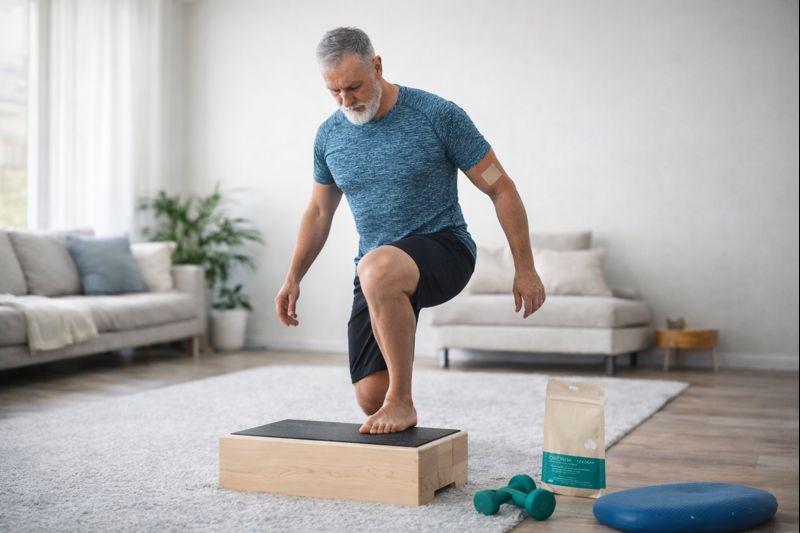
The 5-minute balance routine (do this daily)
You’ll need a chair and a counter or wall for light support.
1) Sit-to-Stand (60 seconds)
Sit tall → stand up slowly → sit down slowly.
Do: 8–12 reps.
Tip: Hands are allowed at first—control matters more than difficulty.
2) Supported Single-Leg Stand (60 seconds)
Stand near a counter. Light fingertip support is fine.
Lift one foot slightly and hold.
Do: 30 seconds each side (or 10–15 seconds each side if needed).
3) Heel-to-Toe Walk (60 seconds)
Walk in a straight line with heel touching toe each step.
Do: 10 steps forward + 10 steps back (or turn around carefully).
4) Side-to-Side Weight Shifts (60 seconds)
Feet hip-width apart. Shift weight slowly left/right.
Do: 10 slow shifts each direction.
5) Calf Raises (60 seconds)
Hold the counter lightly. Rise slowly → lower slowly.
Do: 10–15 reps.
That’s it. The goal is repeatability, not intensity.
The 5-day tracker (so you know it’s working)
Track these once per day (takes 30 seconds):
- Single-leg stand time (best hold each side)
- Confidence score (1–10) (“How steady did I feel today?”)
- Wobble count during heel-to-toe walk
After 5 days, look for:
- slightly longer holds
- fewer wobbles
- a higher confidence score
If the trend is positive, extend to 7–14 days for clearer results.
The biggest mistakes that slow balance progress
Mistake 1: Doing random exercises every day
Balance improves through repetition. Keep the same routine for a week.
Mistake 2: Going too hard
Shaky intensity can train compensation. Slow control trains stability.
Mistake 3: Skipping support tools too early
Using a counter or chair is smart. It keeps the practice safe and consistent.
Mistake 4: Ignoring sleep or discomfort
If you’re not sleeping well or you feel uncomfortable moving, your routine becomes harder to repeat.
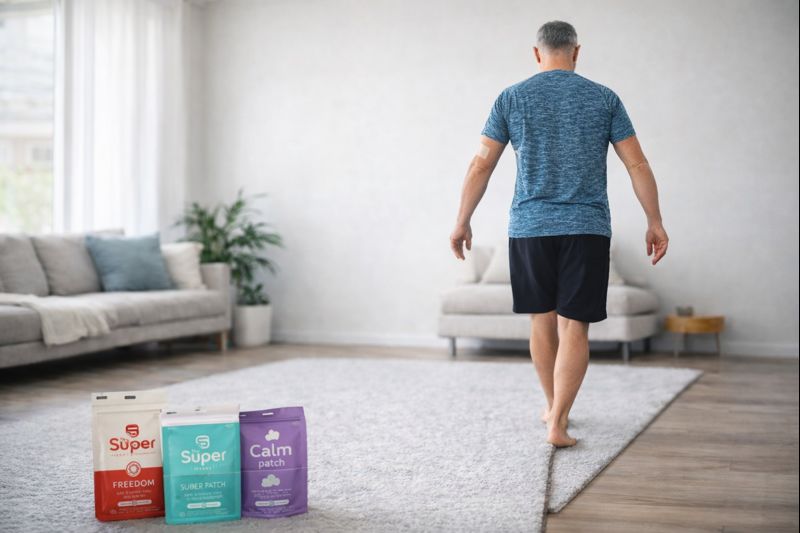
Optional: simple “support tools” to help you stay consistent
If you’re using MyPatchWorks as your support system, many people like starting with a simple 2-goal routine:
Common starter combo for balance consistency
- LIBERTY (balance / stability support)
- FREEDOM (comfort support so movement feels easier)
If sleep affects your stability the next day
- Add REM (sleep support)
You don’t need to do everything. You need a routine you can repeat.
Sample packs + options:
Shop / Pricing: https://mypatchworks.com/pricing
Cold lead overview: https://mypatchworks.com
For the full overview and recommended combos, visit the hub page:
Balance Patch Hub →
Quick FAQ
How often should I do this routine?
Daily is best (it’s only 5 minutes). If you’re tired, do a lighter version with more support.
How long does it take to improve balance?
Many people notice small improvements in 5–14 days with consistent practice. Bigger changes usually come from 4–8 weeks.
What if I feel unsafe doing balance work?
Use support (counter/chair), slow down, and consider professional guidance if you’ve had recent falls, dizziness, or new weakness.
Bottom line
If you want to improve balance at home, don’t overthink it:
- do the 5-minute routine daily
- track for 5 days
- extend to 7–14 days if it’s trending well
- keep your plan simple enough to repeat
Next steps:
Disclaimer: This content is for general educational purposes and is not medical advice. Results vary by person.