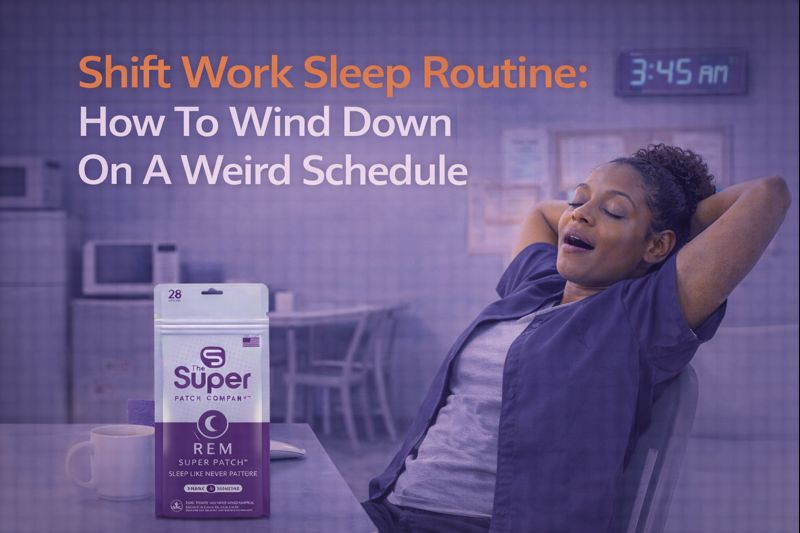
If you work nights, rotating shifts, on-call, or unpredictable hours, most sleep advice is useless.
“Go to bed at the same time every night.”
Cool. Must be nice.
When your schedule is chaotic, the goal isn’t perfection.
It’s building a wind-down routine that works no matter what time you’re going to sleep.
This post gives you a simple system you can repeat, plus a tracking method so you know what’s helping (results vary).
Disclaimer: This content is for general educational purposes and is not medical advice. Patches aren’t intended to diagnose, treat, cure, or prevent disease. Results vary by person.
Quick start (recommended)
- Sleep Patch Hub →
- If stress keeps you wired: Stress Relief Patch Hub →
- Shop / Sample Pack: https://mypatchworks.com/pricing
The #1 shift work sleep rule: anchor your routine, not your bedtime
You may not control your bedtime.But you can control your wind-down sequence.
So instead of “bedtime at 10 PM,” your anchor becomes:
✅ “I start my wind-down 60 minutes before sleep.”
That’s the habit that creates consistency on an inconsistent schedule.

The Shift Work Wind-Down Routine (60 minutes total)
Use this the same way whether you’re going to sleep at 9 AM, 2 PM, or 3 AM.
T-minus 60 minutes: downshift the environment
Pick two:
- dim lights (or keep only one lamp on)
- lower volume / slower content
- stop work messages if possible
- set your room cooler if you can
This tells your brain: “We’re done.”
T-minus 45 minutes: apply your sleep routine support
If you’re using a sleep patch routine, apply it 30–60 minutes before you plan to sleep.
Start here:
Best practices:
- clean, dry skin
- avoid lotion right before
- choose a comfortable, flat spot
- rotate placement if skin gets sensitive
T-minus 30 minutes: nervous system reset (5 minutes)
Do this breathing reset:
- inhale through nose 4 seconds
- exhale slowly 6–8 seconds
- repeat 6–10 breaths
If you’re coming off a stressful shift, this step matters more than any “sleep hack.”
If stress is a big factor, add this:
T-minus 20 minutes: reduce stimulation (the “no doom scroll” rule)
The fastest way to ruin shift-work sleep is to keep your brain in high gear.
Try one:
- quiet music
- a familiar show you’ve already seen (low novelty)
- light reading (nothing intense)
- simple shower routine
Keep it boring on purpose.
T-minus 5 minutes: final cue
Choose one “sleep cue” you always do:
- same pillow spray
- same short prayer / gratitude list
- same 60-second stretch
- same fan / white noise on
Shift workers win when sleep becomes a pattern, not a battle.
The two biggest shift work problems (and fixes)
1) You’re exhausted but wired
That’s stress hormones + stimulation.
Fix:
- keep the 5-minute breathing reset
- use the boring content rule
- consider a stress support routine via a stress-relief-patch.
2) You wake up too early and can’t fall back asleep
Fix:
- keep your room darker
- use consistent noise (fan/white noise)
- track awakenings so you can see if they reduce over the week

The 7-sleep tracker for shift workers (super simple)
Because your sleep times change, your tracking should be minimal.
After you wake up, log:
- Fall-asleep time: fast / medium / long
- Wakeups: 0 / 1–2 / 3+
- Morning rating (1–10): ___
Optional:
- How wired did you feel before sleep? (1–10): ___
After 7 sleeps (not 7 calendar days):
- keep what’s working
- change one thing (light, noise, timing, stress routine)
Bonus: caffeine timing for weird schedules (simple guideline)
Shift workers often struggle because caffeine is too close to sleep.
Simple rule of thumb:
- try to stop caffeine 6–8 hours before your planned sleep window(results vary by person)
Even small changes here can make your wind-down routine work better.
Bottom line
You don’t need a perfect bedtime.You need a repeatable wind-down.
Start your routine 60 minutes before sleep, regardless of the clock:
- downshift environment
- apply sleep routine support (30–60 minutes before sleep)
- 5-minute breathing reset
- boring content
- one final “sleep cue”
Then track 3 outcomes so you’re not guessing.
Next steps
Disclaimer: This content is for general educational purposes and is not medical advice. Results vary by person.