If you’re comparing a balance patch vs balance exercises, you might be asking:
“Do I really need the exercises if I’m using a support tool?”
or “Can the exercises work without anything else?”
Here’s the most practical answer:
✅ Support tools can help.
✅ Exercises build the skill.
✅ Combining both is usually where consistency and results improve (results vary).
This guide explains why you need both, how to combine them without overwhelm, and a simple routine you can repeat daily.
Disclaimer: This content is for general educational purposes and is not medical advice. If you have frequent falls, dizziness, new weakness, numbness, or sudden balance changes, consult a healthcare professional.
Quick start
- Balance routines + basics: Balance Patch Hub →
- New to patches? Start Here →
- Shop: https://mypatchworks.com/product
- Pricing / sample options: https://mypatchworks.com/pricing
Think of balance like brushing your teeth
A patch is like a helpful tool.
But balance itself is a skill — built by repetition.
Just like:
- a good toothbrush helps
- but you still have to brush consistently
Support tools help — but the routine is what compounds.
Balance patch vs balance exercises (what each one does)
What balance exercises do
Exercises train:
- ankle stability
- core control
- coordination
- confidence during movement
- ability to correct small wobbles
This is the “skill-building” side.
What a balance patch can do (routine support)
A patch can be useful as part of a routine because it may help you:
- stay consistent
- feel supported during daily movement
- reinforce a stable daily practice
(Results vary.)
But a patch doesn’t replace training the skill.
Why using both works best
Balance improves when you combine:
- a consistent daily routine
- a small, safe practice that challenges you gently
- simple tracking so you can see progress
A patch may support the routine.
Exercises build the skill.
The simplest way to combine both (no overwhelm)
The 5-minute daily routine (repeatable)
Do this once per day, near a counter or sturdy chair:
- Posture + breathing reset (60 seconds)
- Weight shifts left/right (60 seconds)
- Heel-to-toe rocking (60 seconds)
- March in place (60 seconds)
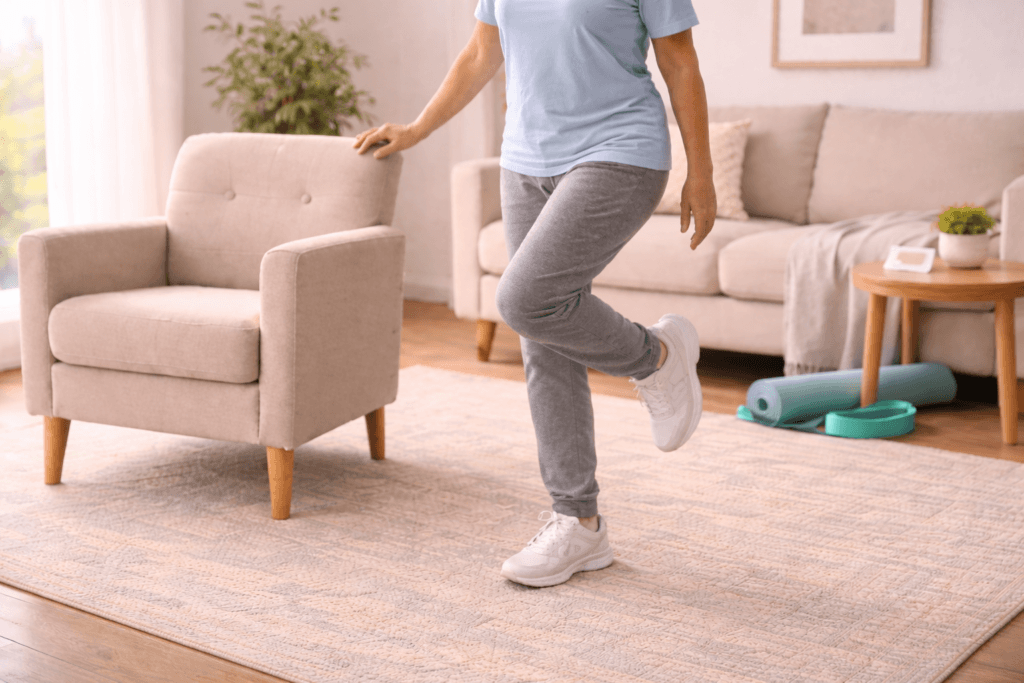
- Single-leg support practice (60 seconds, use support)
That’s it. Five minutes.
If you want the senior-friendly version:
For more variations:
How to stack this into your day (best time to do it)
Pick one consistent time:
- morning (fresh nervous system)
- midday (reset)
- evening (wind-down + practice)
Consistency matters more than the “perfect” time.
How to track progress (so you know it’s working)
For 7 days, track:
- Stability confidence (1–10): ___
- Wobble today: low / medium / high
- Later-in-day stability: better / same / worse
Optional:
- Near slips? yes/no
- Energy (1–10): ___ (fatigue affects balance)
This turns vague feelings into clear trends.
Common mistakes (and quick fixes)
Mistake #1: doing too much too soon
Fix: keep it 5 minutes.
Mistake #2: practicing only when you remember
Fix: attach it to a habit (after brushing teeth, after morning coffee, etc.)
Mistake #3: skipping safety
Fix: always use support (counter/chair) if you’re unsteady.
Mistake #4: expecting overnight change
Fix: track for 7 days. Balance improves by repetition.
Bottom line
Balance patch vs balance exercises?
You need both because they do different jobs:
- a support tool may help your routine (results vary)
- exercises build the balance skill
- together, they create consistency — and that’s what compounds
Next steps:
Disclaimer: This content is for general educational purposes and is not medical advice. Results vary by person.