
If you’re trying patches for the first time, this is the most honest question you can ask:
How long does it take to work?
Because you don’t want hype. You want clarity.
Here’s the truth:
Some people notice changes quickly. Some people need more time.
Results vary.
But there is a faster way to know whether something is helping:
✅ run a clean 7-day test
✅ track a few simple signals
✅ adjust one variable at a time
This guide shows you exactly how to do that.
Disclaimer: This content is for general educational purposes and is not medical advice. Patches aren’t intended to diagnose, treat, cure, or prevent disease. Results vary by person.
Quick start (recommended)
- Not sure which goal to start with? Start Here →
- Want the fastest low-commitment test? Sample Pack →
Jump to your goal hub:
- Sleep Patch Hub →
- Stress Relief Patch Hub →
- Energy Patch Hub →
- Focus Patch Hub →
- Mood Patch Hub →
- Comfort / Pain Relief Patch Hub →
- Recovery / Performance Patch Hub →
- Balance Patch Hub →

The honest answer: it depends (and that’s why tracking matters)
How fast you notice change depends on things like:
- your starting baseline (sleep debt, stress load, routines)
- how consistent you are (timing, placement, daily use)
- the goal you’re targeting (sleep vs energy vs comfort)
- your lifestyle factors (caffeine, alcohol, heavy meals, training, work schedule)
That’s why two people can have two different experiences.
So instead of asking, “Should I feel something immediately?” …
Ask:
“What should I track so I can see trends?”
What to expect in the first few days (realistic)
Days 1–2: “Is this doing anything?”
Often you’re just getting used to the routine.
Don’t judge the whole system off one day.
Days 3–5: subtle signals show up
Many people first notice things like:
- slightly easier wind-down
- fewer stress spikes
- smoother afternoons
- better focus for one work block
- waking up feeling a bit more restored(Results vary.)
Days 6–7: trends become clearer
Tracking starts to show whether something is consistently improving.
The 7-day test (fastest way to know)
Step 1 — Pick ONE main goal
Choose the one that matters most right now:
- sleep
- stress/calm
- energy
- focus
- mood
- comfort/movement
- recovery/performance
- balance
If you’re unsure, start here:
Step 2 — Keep your routine consistent for 7 days
For the week:
- don’t change timing every day
- don’t change placement every day
- don’t add 3 new supplements and a new bedtime routine at the same time
- keep the number of patches the same if you’re stacking
Consistency is what makes results readable.
Step 3 — Track 3 signals (15 seconds per day)
If your goal is sleep
- fall asleep time: fast / medium / long
- wakeups: 0 / 1–2 / 3+
- morning rating (1–10)
Go deeper here:
If your goal is stress/calm
- tension (1–10)
- mental noise (1–10)
- recovery speed after stress: fast / medium / slow
Go deeper here:
If your goal is energy
- 2–4 PM slump intensity (1–10)
- recovery time after reset (2 / 5 / 10+ minutes)
- afternoon focus (1–10)
Go deeper here:
If your goal is focus
- start resistance (1–10)
- focus quality (1–10)
- progress made (one sentence)
Go deeper here:
If your goal is mood
- mood (1–10)
- stress (1–10)
- sleep quality (1–10)
Go deeper here:
If your goal is comfort/movement
- comfort level (1–10)
- ease of movement (1–10)
- sleep quality (1–10)
Go deeper here:
Step 4 — After 7 days, adjust ONE variable
If you notice improvement:
- keep it steady for another week
- then consider stacking a second goal
If you notice no change:
- adjust one variable:
- timing
- placement
- supporting habit (wind-down, hydration, midday reset)
- or switch to a more relevant goal hub
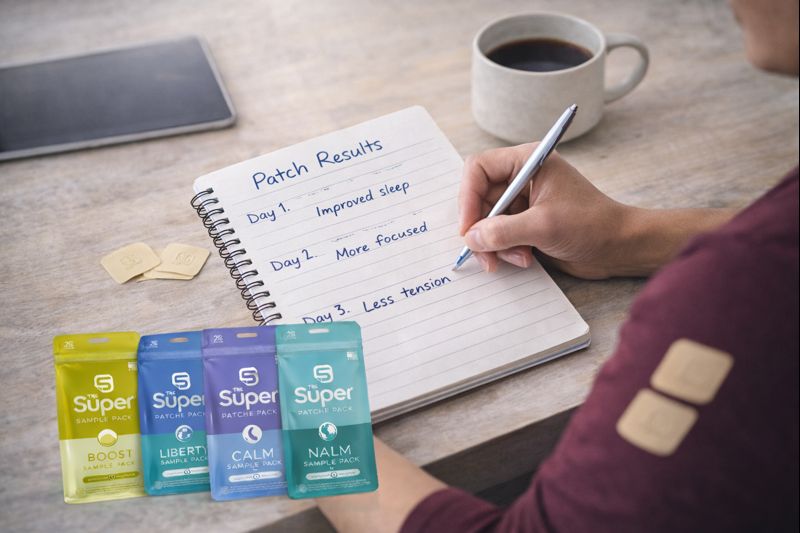
The easiest way to test without committing (sample pack)
If you want a low-commitment way to run a clean 7-day test:
Pick one goal, track 3 signals, and decide based on trends — not guesses.
Bottom line
How long does it take for a patch to work?
It varies. But you don’t have to guess.
The fastest way to know is:
- pick one goal
- run a clean 7-day routine
- track 3 signals
- adjust one variable at a time
That turns “I’m not sure” into a clear answer.
Next steps
- Start Here →
- Choose your goal hub:
- Shop / Sample Pack →
Disclaimer: This content is for general educational purposes and is not medical advice. Results vary by person.