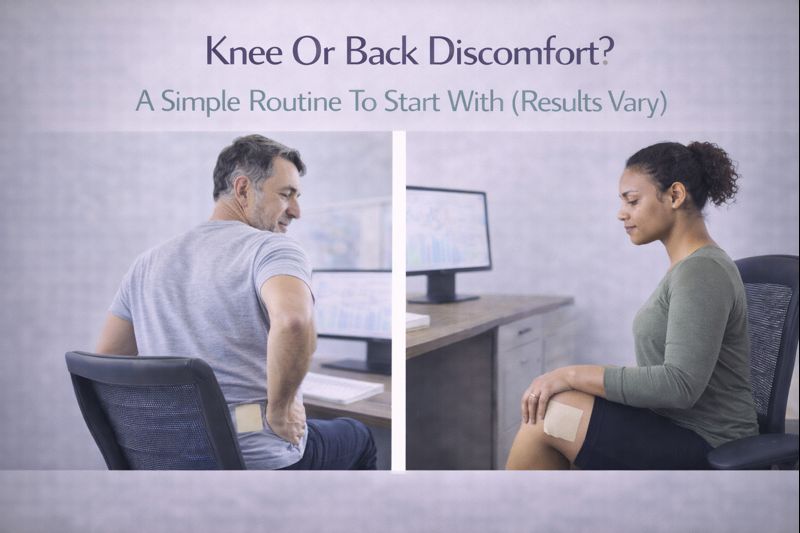
When your knees or back feel “off,” it’s tempting to chase the perfect solution.
But most people get better results with something simpler: a repeatable routine you can actually stick to for a full week.
This post gives you a starter plan you can run for 7 days—plus a few easy adjustments depending on whether your discomfort shows up more in your knees, your back, or both.
Disclaimer: This content is for general educational purposes and is not medical advice. Patches aren’t intended to diagnose, treat, cure, or prevent disease. Results vary by person.
Quick start (recommended)
- Want the full comfort-support system? Pain Relief Patch Hub →
- Want steadier movement support too? Balance Patch Hub →
- If sleep affects how you feel: Sleep Patch Hub →
- Shop / Sample Pack: https://mypatchworks.com/pricing
The simplest explanation (why knees and backs flare up)
Most day-to-day knee or back discomfort tends to come from some mix of:
- too much sitting (hips tighten, back gets “stuck”)
- too much standing (fatigue + posture breakdown)
- too little movement variety (same positions all day)
- poor recovery (sleep and stress make everything feel worse)
That’s why the best starter plan includes:
- comfort support
- basic stability/movement work
- recovery at night

The 7-day starter routine (simple + repeatable)
Morning (Daytime routine)
Step 1 — Choose 1 comfort-support goal
Many people start with a comfort-support patch as part of their routine (often FREEDOM).
Step 2 — Add 3 minutes of “easy movement”
Pick one of these and do it daily:
- 3–5 minute walk (inside counts)
- Sit-to-stand x 8–12 reps (slow and controlled)
- Supported hip hinge x 8 reps (hands on thighs, small range)
Why: you’re teaching your body “we move safely” instead of bracing all day.
Midday (60–90 seconds — the anti-stiffness reset)
This matters more than people expect.
Do:
- 10 calf raises
- 10 slow side-to-side weight shifts
- 5 slow breaths (long exhale)
If you only do one thing besides the patch routine, do this.
Night (Recovery routine)
If you wake up feeling worse after poor sleep, add the simplest night stack first.
Many people use REM as part of a night routine.
Next step:
Knee-focused version (if knees are your main issue)
Keep the same routine above, but choose these movement options:
- Sit-to-stand (slow, controlled)
- Short walks (frequent beats long)
- Calf stretch against a wall (30 seconds/side)
Avoid trying to “push through” deep knee bends early on. Keep range small and consistent.
Back-focused version (if back is your main issue)
Keep the same routine above, but choose these movement options:
- 3–5 minute walk
- Hip hinge (small range, slow)
- Gentle glute squeeze holds (5 reps of 5 seconds)
Back routines usually win when they’re daily and small, not intense.

The best 2-goal starter combos to test (results vary)
If you want the simplest approach, start with two goals:
Option A: Comfort + Balance support
A common routine pairing is FREEDOM + LIBERTY (comfort + steadier movement support).
- Learn more here: Pain Relief Patch Hub →
- And here: Balance Patch Hub →
Option B: Comfort + Sleep support
If nights are rough, add REM before you add more daytime changes.
And if you want the simplest way to test without overthinking: Sample Pack →
The 7-day tracker (so you’re not guessing)
Track once daily (15 seconds):
- End-of-day comfort (1–10)
- Movement ease (1–10)
- Sleep quality (1–10)
After 7 days:
- If scores trend better → keep the routine another 7–14 days
- If nothing changes → change one variable (timing, placement, or swap one goal), not everything at once
Common mistakes (and quick fixes)
Mistake #1: Changing the routine every day
Fix: run it for 7 days unchanged.
Mistake #2: Only focusing on daytime, ignoring recovery
Fix: add a simple night routine.
Mistake #3: Doing too much too soon
Fix: “small + daily” beats “hard + random.”
Next steps
Disclaimer: This content is for general educational purposes and is not medical advice. Results vary by person.